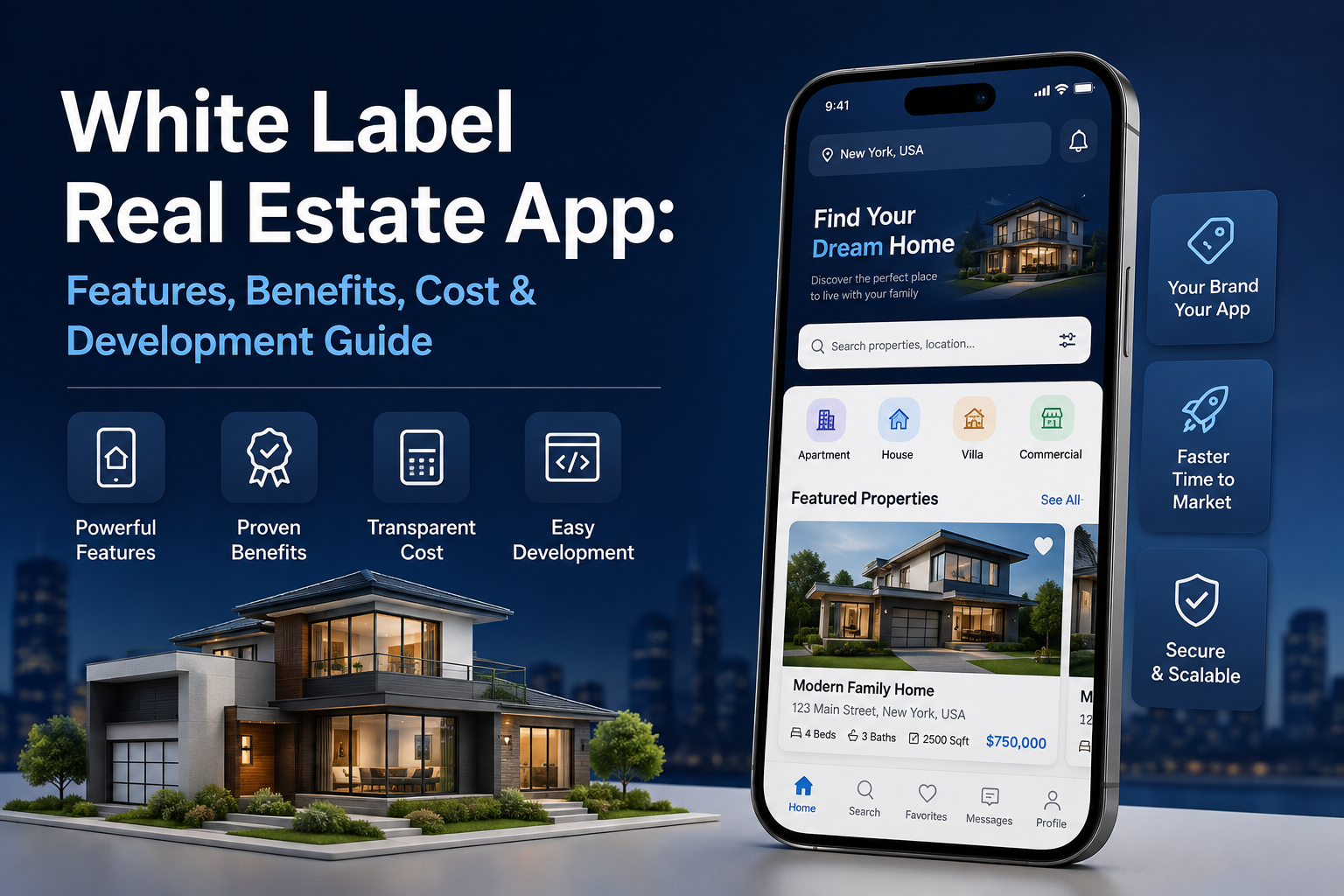
The real estate industry has become increasingly digital. Buyers, tenants, landlords, agents, and property managers now expect to search properties, compare listings, schedule visits, communicate with agents, and manage property-related activities online.
For businesses entering the PropTech market, building a real estate application from scratch can require a significant investment of time and money. A white label real estate app offers a faster alternative.
Instead of developing every feature from the ground up, businesses can start with a ready-made real estate platform, customize it with their own branding, and launch it as their own application.
But what exactly is a white label real estate app? What features should it include? How much does it cost? And when is it a better option than custom development?
This guide covers everything you need to know before choosing a white label real estate app development solution.
What Is a White Label Real Estate App?
A white label real estate app is a pre-built property application that can be customized and launched under another company’s brand.
The core technology is already developed, while businesses can customize elements such as:
- Logo and brand name
- Colors and fonts
- App icon
- Splash screen
- Domain
- Property categories
- Search filters
- User roles
- Payment options
- Admin settings
- Integrations
A typical platform can include separate experiences for property buyers, tenants, agents, landlords, brokers, and administrators.
The biggest difference between a white label solution and a custom application is that businesses do not have to start development from zero.
How Does a White Label Real Estate App Work?
The process is relatively straightforward.
First, a business selects a ready-made real estate application from a development provider. The provider then applies the company’s branding and configures the application based on its requirements.
Depending on the provider, the process can include:
- Selecting the real estate app solution
- Choosing the required features
- Providing branding assets
- Configuring the application
- Adding APIs and integrations
- Testing the application
- Deploying the mobile apps
- Launching the platform
For example, Pre Built Apps’ White Label Real Estate App currently includes a buyer app, agent panel, and master admin panel, along with features such as map-based property search, mortgage calculations, virtual tours, agent CRM, and lead routing.
Why Choose a White Label Real Estate App?
A white label solution is not simply about getting an application at a lower price. It can also reduce development time and allow a business to focus on launching and growing its real estate marketplace.
Faster Time to Market
Custom real estate application development can take several months because the product needs to go through planning, design, development, testing, integrations, and deployment.
A ready-made platform already has the core functionality in place.
This allows businesses to move more quickly from an idea to a working product.
Lower Development Costs
Building a real estate app from scratch means paying for every stage of development.
A white label platform can reduce the initial development investment because the core product has already been created.
For example, Pre Built Apps currently lists its white label real estate app at $9,999, while its site estimates that a comparable custom real estate application can cost $80,000 or more.
The actual cost of any application will depend on its features, integrations, customization, and development requirements.
Ready-Made Features
Businesses do not have to spend development resources creating basic functionality such as property search, listing management, user accounts, maps, or administration from scratch.
Custom Branding
A white label app can be made to look like the company’s own product.
This can include:
- Logo
- Brand colors
- App icon
- Splash screen
- Domain
- Store listings
The goal is for customers to interact with the business’s brand rather than the technology provider.
Easier Business Validation
For startups, launching quickly can be more valuable than spending months building a highly customized product before knowing whether customers want it.
A white label application can help businesses test their concept, acquire users, and collect feedback before making larger investments.
Key Features of a White Label Real Estate App
The features included in a white label real estate app will vary by provider. However, a professional platform should cover the major requirements of a modern property marketplace.
Property Listing Management
Property listing management is the foundation of any real estate platform.
Agents, landlords, or administrators should be able to add and manage property information, including:
- Property images
- Property descriptions
- Price
- Location
- Property type
- Bedrooms
- Bathrooms
- Amenities
- Property size
- Availability
An effective listing system should also make it easy to update or remove properties.
Advanced Property Search
Users should be able to find properties based on their specific requirements.
Common search filters include:
- Location
- Price range
- Property type
- Bedrooms
- Bathrooms
- Property size
- Amenities
- Sale or rental status
More advanced platforms can also provide map-based search and location-based discovery.
Map-Based Property Search
Maps are particularly useful for real estate platforms because location plays a major role in property decisions.
A map-based interface can allow users to:
- Search properties around a location
- View nearby listings
- Explore neighborhoods
- Compare properties by location
- Open property details directly from the map
Pre Built Apps includes map-based property search as part of its listed real estate package.
Agent Profiles
Real estate agents are an important part of many property marketplaces.
An agent profile can include:
- Agent name
- Profile photo
- Contact information
- Listings
- Reviews
- Areas served
- Professional information
This can help users identify and contact the right agent.
Agent CRM and Lead Management
A real estate app should not only generate property inquiries but also help agents manage those leads.
A CRM can allow agents to:
- View leads
- Assign leads
- Track inquiries
- Follow up with potential customers
- Manage customer information
- Monitor lead status
Pre Built Apps lists an agent CRM and lead routing functionality as part of its real estate app package.
Mortgage Calculator
A mortgage calculator can help potential buyers estimate their monthly payments based on factors such as:
- Property price
- Down payment
- Interest rate
- Loan duration
This type of functionality can increase engagement by giving users useful information directly within the property platform.
Virtual Tours and 3D Walkthroughs
Virtual tours allow users to explore properties without physically visiting them.
This can be especially useful for:
- International buyers
- Remote buyers
- Luxury properties
- Commercial properties
- Rental properties
Virtual-tour functionality can also help agents reduce unnecessary physical visits.
Favorites and Saved Properties
Users should be able to save properties they are interested in and return to them later.
This simple feature can improve the browsing experience and encourage users to return to the application.
Property Comparison
Property comparison allows users to compare multiple properties based on factors such as:
- Price
- Location
- Size
- Bedrooms
- Bathrooms
- Amenities
This can make it easier for buyers or renters to shortlist properties.
Push Notifications
Notifications can keep users informed about:
- New properties
- Price changes
- New inquiries
- Appointment updates
- Messages
- Saved-search alerts
- Application updates
Admin Dashboard
A master admin panel gives the business control over the platform.
An admin dashboard can include:
- User management
- Agent management
- Property management
- Listing approval
- Lead management
- Payment management
- Reports
- Notifications
- Content management
A strong administration system is particularly important as the number of users and listings increases.
Multi-Language and Multi-Region Support
Businesses operating across different markets may need multiple languages, currencies, locations, and regional configurations.
This can make the platform easier to expand into new markets without rebuilding the application.
Pre Built Apps currently lists multi-language and multi-region support among the features of its real estate package.
Benefits of a White Label Real Estate App for Businesses
Beyond faster development, a white label platform can provide several business advantages.
Launch Without Building From Scratch
Businesses can avoid spending months developing basic marketplace functionality.
Focus on Customer Acquisition
Instead of directing most of the budget toward development, businesses can allocate resources toward:
- Marketing
- Agent acquisition
- Property listings
- Customer support
- Partnerships
- Sales
Reduce Technical Complexity
The provider handles much of the underlying development work, allowing the business team to focus on its market and customers.
Build a Branded Property Platform
The application can be customized to match the company’s visual identity and business model.
Scale as the Business Grows
A good platform should provide a foundation that can support more users, properties, agents, and locations as the business expands.
How Much Does a White Label Real Estate App Cost?
The cost of a white label real estate app depends on the provider, features, customization, integrations, platforms, and ownership terms.
Some important factors include:
- iOS application
- Android application
- Web application
- Admin dashboard
- Agent panel
- UI/UX customization
- Maps
- Mortgage calculator
- CRM
- Virtual tours
- Payment integrations
- Third-party APIs
- Multi-language support
- Source-code ownership
- Hosting
- Maintenance
- Post-launch support
Pre Built Apps Pricing
For businesses specifically considering Pre Built Apps, its current published package is $9,999 one-time.
The package includes:
- Buyer app for iOS and Android
- Agent panel
- Master admin panel
- Custom branding
- Map-based property search
- Mortgage calculator
- Virtual tours and 3D walkthroughs
- Lead management CRM
- Agent verification
- Multi-language and multi-region support
- Three months of support
- Deployment
Source-code ownership is currently available for an additional $999. The company states a standard delivery timeframe of 3–5 working days.
Pre Built Apps also states that its standard package uses a fixed-price model and includes deployment and three months of support.
How Does the Price Compare With Other Options?
Market pricing can vary considerably.
For example, Make An App Like currently lists ready-made clone applications in a broader $4,500–$18,000 range, with its Zillow-style real estate clone listed from $4,999 on its catalogue. It states that its white-label clones generally launch within 14–30 days and include source code.
Sell My Code’s Real Estate Listing Platform is currently listed at $8,400. The product includes features such as map search, agent portals, lead CRM, mortgage and valuation tools, MLS importing, e-sign rental applications, and iOS and Android applications.
These examples show why businesses should compare the complete package, rather than comparing the headline price alone.
A lower starting price may not include the same features, support period, deployment services, customization, or source-code terms.
What Is Included in the Development Cost?
Before purchasing a white label application, ask the provider exactly what the quoted price includes.
Application Development
Confirm whether the price covers:
- iOS
- Android
- Web
- Admin panel
- Agent panel
Branding
Check whether your logo, colors, app icon, domain, and store branding are included.
Deployment
Find out whether the provider handles:
- App Store deployment
- Google Play deployment
- API configuration
- Server setup
- Admin panel deployment
Support
Ask how long technical support is included and what it covers.
Source Code
Source-code ownership can be particularly important for businesses that want long-term control over their platform.
For example, Pre Built Apps lists source-code ownership as a $999 optional add-on.
How to Choose the Right White Label Real Estate App Provider
Choosing the right provider requires more than comparing prices.
Check the Live Demo
Request a live demo and test the application yourself.
Look at the experience from the perspective of:
- Buyer
- Tenant
- Agent
- Property owner
- Administrator
Review the Feature List
Make a list of the features your business actually needs and compare them against the provider’s package.
Ask About Customization
Find out whether customization is limited to branding or whether you can modify workflows, features, and integrations.
Check Source-Code Ownership
If you want to make changes independently in the future, clarify whether source code is included.
Evaluate Scalability
Ask how the platform handles increasing numbers of:
- Users
- Properties
- Agents
- Listings
- Locations
- Leads
Check API Integrations
Your business may require integrations with:
- Maps
- Payment gateways
- CRM systems
- Property databases
- Analytics
- Communication platforms
- Identity verification services
Review Support and Maintenance
Ask about:
- Bug fixes
- Security updates
- OS updates
- App-store updates
- Performance improvements
- Future feature development
When Should You Choose a White Label Real Estate App?
A white label solution can be a good choice when your business:
- Wants to launch quickly
- Has a limited initial development budget
- Needs standard real estate features
- Wants to test a business model
- Needs custom branding
- Does not want to build basic functionality from scratch
It can be particularly useful for:
- Real estate startups
- Property marketplaces
- Real estate agencies
- Independent brokers
- Property management companies
- PropTech entrepreneurs
- Real estate franchises
When Is Custom Real Estate App Development Better?
White label is not the right option for every business.
Custom development may be better if you require:
- Highly specialized workflows
- Proprietary algorithms
- Complex integrations
- Unique business logic
- Advanced AI functionality
- Complete architectural control
- A completely different user experience
For these businesses, the additional investment in custom development may provide more flexibility over the long term.
How Long Does It Take to Launch a White Label Real Estate App?
The timeline depends on the provider and the level of customization.
A traditional custom application can take several months because the entire product needs to be designed, developed, tested, and deployed.
By comparison, Pre Built Apps currently states that its standard white label real estate application can be delivered in 3–5 working days after the required branding and configuration are finalized.
Make An App Like states that its white-label clone products generally launch within 14–30 days, while Sell My Code lists its real estate listing platform as capable of launching in 2–7 days.
Therefore, businesses should ask exactly what “launch time” means. It may refer to delivery of the application, while app-store approval, custom development, data migration, and third-party integrations can require additional time.
How Can a Real Estate App Make Money?
Launching an application is only one part of the business model. A real estate platform also needs a clear monetization strategy.
Featured Property Listings
Property owners and agents can pay to promote their listings.
Agent Subscriptions
Agents can purchase monthly or annual plans to access premium features.
Lead Generation Fees
The platform can charge agents for qualified leads.
Pre Built Apps describes a potential pay-per-lead model in which agents can be charged for qualified property leads.
Listing Fees
Property owners or agents can pay to publish listings on the platform.
Transaction Fees
A marketplace can potentially charge a percentage of certain transactions where the business model supports transaction processing.
Advertising
Businesses can sell advertising placements to relevant real estate service providers.
Final Thoughts
A white label real estate app can provide a practical way to enter the PropTech market without spending months building every component from scratch.
For startups, agencies, brokers, and property businesses, the main advantages are faster deployment, lower initial development requirements, ready-made functionality, and customizable branding.
However, choosing the right platform requires careful evaluation. Look beyond the initial price and compare features, customization, integrations, scalability, source-code ownership, deployment, and support.
For businesses evaluating Pre Built Apps, the current $9,999 package includes the buyer app, agent panel, admin panel, branding, property search, mortgage calculator, virtual tours, CRM, and other real estate functionality, with source-code ownership available as an additional $999. The company currently states a 3–5 working day standard delivery timeframe.
Ultimately, the best white label real estate app development solution is one that gives your business a strong technical foundation while leaving enough flexibility to build your own brand, acquire users, onboard property professionals, and scale into new markets.