Modern manufacturing depends on components that are clean to a consistent, repeatable standard, whether they go into an engine assembly, a precision instrument, or a sealed electronic housing. As production volumes grow and quality tolerances tighten, manual cleaning methods increasingly struggle to keep pace. This is where a Fully Automatic Ultrasonic Cleaning Plant becomes relevant. By combining ultrasonic cleaning technology with automated handling and process control, these systems help manufacturers reduce manual effort while achieving cleaning results that are consistent from the first batch to the last.
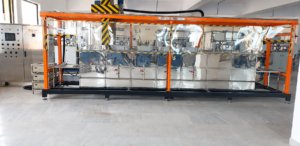
This article explains what a fully automatic ultrasonic cleaning plant is, how it works, the benefits it offers, and the key features buyers should evaluate before investing in one.
What Is a Fully Automatic Ultrasonic Cleaning Plant?
A fully automatic ultrasonic cleaning plant is an industrial cleaning system that uses ultrasonic cleaning technology, combined with automated material handling, to clean components without requiring an operator to move parts between stages manually.
At the core of the process is cavitation. Ultrasonic transducers generate high-frequency sound waves that pass through a liquid cleaning solution, creating millions of microscopic bubbles. These bubbles rapidly form and collapse, releasing energy that dislodges oils, grease, dust, and other contaminants from component surfaces — including areas that are difficult to reach with brushes or manual wiping.
In a fully automatic system, components are moved through the cleaning, rinsing, and drying stages using automated handling mechanisms such as robotic arms, indexing conveyors, or programmable lift-and-transfer systems, depending on the plant’s design. The entire sequence is managed through digital controls, which allow operators to set and monitor parameters such as cycle time, temperature, and process stage sequencing.
This level of automation supports repeatable cleaning cycles, an important requirement in industries where inconsistent cleaning can affect downstream processes such as coating, assembly, or inspection.
How Does a Fully Automatic Ultrasonic Cleaning Plant Work?
While exact configurations vary by manufacturer and application, a typical automated ultrasonic cleaning process generally follows these stages:
- Loading: Components are loaded into baskets, fixtures, or carriers, either manually or via automated feeding systems.
- Pre-cleaning (where applicable): Heavily soiled parts may pass through an initial rinse or degreasing stage.
- Ultrasonic cleaning: Components are immersed in a cleaning tank where ultrasonic cavitation removes surface contaminants.
- Rinsing: Parts move to a rinse tank to remove residual cleaning solution.
- Additional treatment stages (where required): Some processes include secondary cleaning, passivation, or chemical treatment stages depending on the application.
- Final rinsing: A final rinse ensures the component surface is free of process chemicals.
- Drying: Hot air drying, vacuum drying, or other drying methods remove residual moisture.
- Unloading or transfer: Cleaned components are unloaded or transferred to the next stage of production.
The exact configuration — number of stages, tank sizes, and handling method — is typically selected based on component geometry, the type of contamination being removed, required throughput, and specific customer requirements.
Key Benefits of a Fully Automatic Ultrasonic Cleaning Plant
Manufacturers consider automated ultrasonic cleaning systems for several practical reasons:
- Consistent cleaning performance across production batches, since process parameters are digitally controlled rather than dependent on manual technique.
- Reduced manual intervention, which lowers the chance of operator-to-operator variation in cleaning outcomes.
- Better process repeatability, useful for industries with strict quality or traceability requirements.
- Effective removal of oils, grease, dust, and similar contaminants from component surfaces, including complex geometries.
- Improved production efficiency by integrating multiple cleaning stages into one continuous process.
- Reduced component handling, which can help lower the risk of damage or contamination during transfer between stages.
- Suitability for high-volume production, where manual cleaning would otherwise become a bottleneck.
- Controlled cleaning parameters such as temperature, cycle time, and solution concentration, set and monitored digitally.
It’s worth noting that outcomes depend on correct configuration for the specific application — frequency, power, solution chemistry, and exposure time all need to be matched to the component and contaminant type. Claims of universal or guaranteed results should always be evaluated against the specifics of a given process.
Key Features to Look for in a Fully Automatic Ultrasonic Cleaning Plant
When evaluating an automated ultrasonic cleaning system, buyers typically assess the following:
- Ultrasonic frequency and power: Different frequencies suit different component sizes and contamination types.
- Tank configuration: Number, size, and arrangement of cleaning and rinsing tanks.
- Number of cleaning and rinsing stages: More stages generally support higher cleanliness requirements.
- Automated material handling: The mechanism used to move components between stages.
- Digital controls: Programmable logic controllers (PLCs) and touchscreen interfaces for setting and monitoring cycles.
- Temperature control: Heating systems for the cleaning and rinsing solutions.
- Filtration and solution management: Systems that maintain cleaning solution quality over extended use.
- Drying system: Method used to remove moisture after final rinsing.
- Safety features: Interlocks, guarding, and emergency stop mechanisms appropriate to an automated line.
- Process monitoring: Data logging or alarms for out-of-range parameters.
- Customization: Ability to configure the plant around specific component shapes, sizes, and production volumes.
The right combination of these features depends on the parts being cleaned, the contaminants involved, the cleanliness level required, and the production environment.
Industrial Applications
Fully automatic ultrasonic cleaning plants are used across a range of industries where precision component cleaning is important, including:
- Automotive components
- Precision engineering parts
- Metal components
- General engineering and manufacturing parts
- Industrial equipment components
- Any application requiring consistent cleaning of complex geometries or small parts
In these settings, automated ultrasonic cleaning can help reach recesses, threads, and internal cavities that are otherwise difficult to clean manually, while maintaining a repeatable process across large production runs.
Fully Automatic vs. Manual Ultrasonic Cleaning
Choosing between manual and fully automatic ultrasonic cleaning depends on the production environment:
| Factor | Manual Ultrasonic Cleaning | Fully Automatic Ultrasonic Cleaning |
| Manual intervention | Higher — operator loads/unloads and moves parts between stages | Lower — handling is automated |
| Process consistency | Can vary with operator technique | More consistent due to programmed parameters |
| Production volume | Better suited to low-to-moderate volumes | Better suited to medium-to-high volumes |
| Labor requirement | Higher ongoing labor involvement | Lower labor involvement during the cycle |
| Scalability | Limited without additional manpower | Generally easier to scale within plant capacity |
Automatic systems are not automatically the right choice for every operation. Lower-volume or highly variable production environments may still be well served by manual or semi-automatic ultrasonic cleaning, while high-volume, repeatable processes tend to benefit more from full automation.
How to Choose the Right Fully Automatic Ultrasonic Cleaning Plant
Before selecting a system, it helps to evaluate the following:
- Component size, shape, and material
- Type and level of contamination to be removed
- Required cleanliness standard
- Production volume and cycle time needed
- Number of cleaning and rinsing stages required
- Drying requirements
- Available floor space
- Level of automation needed, now and in the future
- Anticipated growth in production volume
Reviewing the actual cleaning process — contaminants, component geometry, and throughput — before selecting equipment helps ensure the plant configuration matches real production needs rather than a generic specification.
Why Ultrasonic Cleaning Is Suitable for Precision Components
Ultrasonic cavitation reaches into blind holes, threads, slots, and other geometrically complex areas that are difficult to access through spraying or manual scrubbing. This makes ultrasonic cleaning a commonly used method for precision components in industries such as automotive and general engineering.
That said, ultrasonic cleaning is not universally suitable for every material or contamination type. Certain delicate materials, coatings, or specific contaminant chemistries require careful evaluation of frequency, power, solution, and exposure time before ultrasonic cleaning is applied.
Conclusion
A fully automatic ultrasonic cleaning plant brings together ultrasonic cavitation and automated handling to deliver a cleaning process that is consistent, repeatable, and suited to higher production volumes. The right system depends on component geometry, contamination type, required cleanliness level, and production throughput — there is no one-size-fits-all configuration. Manufacturers evaluating automated component cleaning should assess their actual process requirements first, then select features and configuration accordingly.
FAQ – Frequently Asked Question
What is a Fully Automatic Ultrasonic Cleaning Plant?
It is an industrial cleaning system that combines ultrasonic cleaning technology with automated component handling, moving parts through cleaning, rinsing, and drying stages with minimal manual intervention.
How does ultrasonic cleaning work?
Ultrasonic transducers generate high-frequency sound waves in a liquid, creating cavitation bubbles that form and collapse rapidly, dislodging contaminants from component surfaces.
What types of contaminants can ultrasonic cleaning remove?
Depending on the process configuration, ultrasonic cleaning can help remove oils, grease, dust, and similar surface contaminants from components.
Which industries use automatic ultrasonic cleaning plants?
Industries such as automotive component manufacturing, precision engineering, metal component production, and general industrial manufacturing commonly use these systems.
What is the difference between ultrasonic cleaning and conventional cleaning?
Ultrasonic cleaning uses cavitation to reach recesses and complex geometries that manual or conventional cleaning methods may not access effectively, and it can be integrated into an automated, repeatable process.
Can an ultrasonic cleaning plant include rinsing and drying stages?
Yes. Fully automatic plants typically integrate cleaning, rinsing, and drying stages into a single automated sequence.
How do I choose the right ultrasonic cleaning system for my components?
Consider component size and material, contamination type, required cleanliness level, production volume, and available floor space before selecting a configuration.
Can ultrasonic cleaning plants be customized for industrial production?
Yes. Tank configuration, number of stages, handling method, and control systems can generally be customized based on component requirements and production goals.
Contact Us
Hisashi Ultrasonic (Hisashi Industries) manufactures and supplies industrial ultrasonic cleaning solutions, including fully automatic ultrasonic cleaning plants configured for a range of component cleaning applications. If you are evaluating automation options for your component cleaning process, you can reach out to discuss your specific requirements — including component geometry, contamination type, production volume, and automation needs — at hisashiultrasonic.com.
Call Now – +91 9871013815
Visit Us – https://hisashiultrasonic.com/