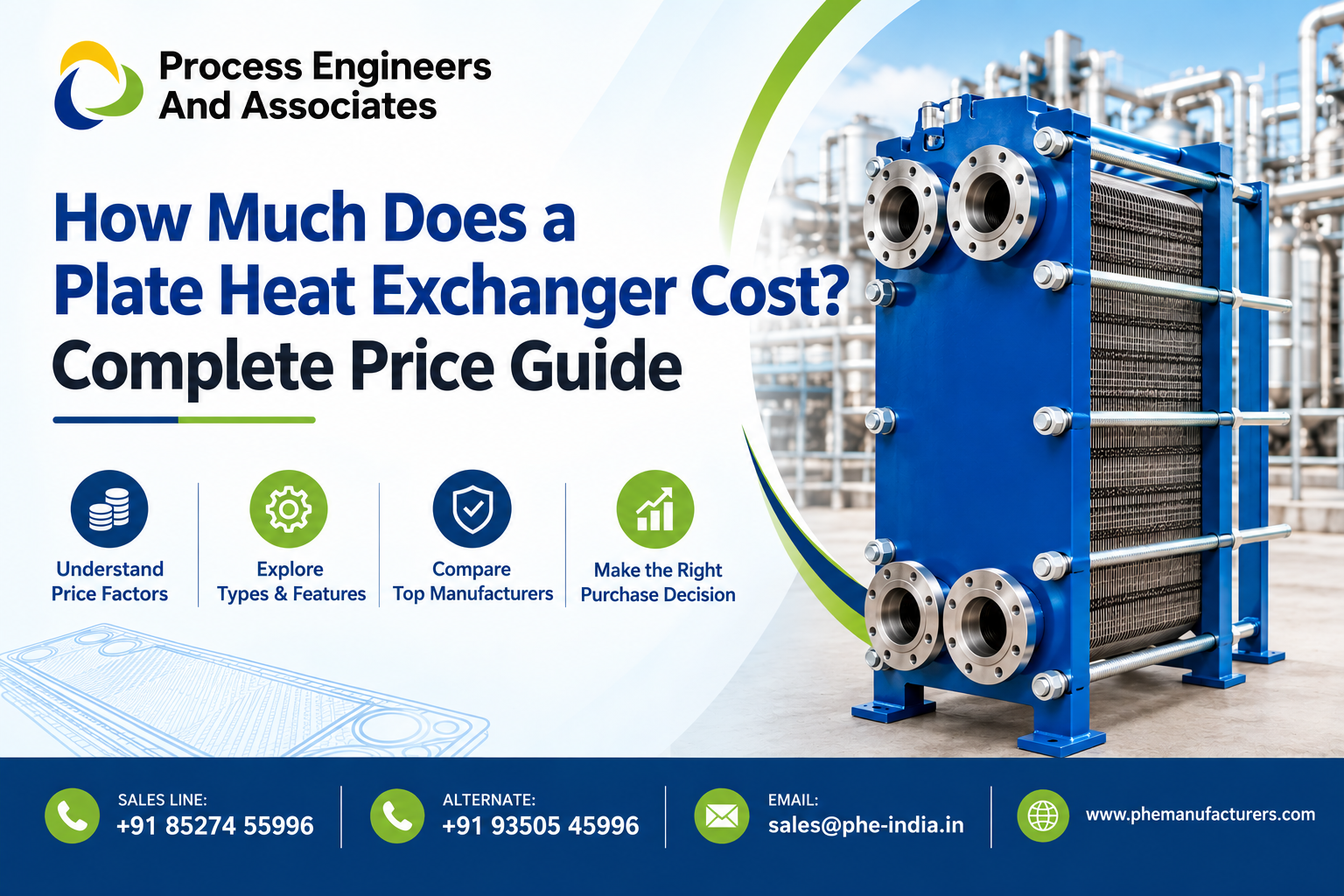
For any plant manager or procurement professional sourcing thermal equipment, one of the first questions that comes up is the plate heat exchanger price. It’s a natural question — budgets need to be planned, quotations need to be compared, and capital equipment purchases need justification. But anyone who has actually requested quotes from two or three manufacturers usually discovers something quickly: the numbers can vary quite a bit, sometimes by a wide margin, even for what looks like “the same” equipment on paper.
The reason is straightforward once you understand it. A plate heat exchanger isn’t a commodity item like a length of pipe or a standard motor. It’s engineered equipment, and its price is a direct reflection of the technical specifications, materials, and application requirements behind it. This guide walks through what actually drives cost, so that buyers can evaluate quotations with more confidence and ask manufacturers the right questions.
What Is a Plate Heat Exchanger?
A plate heat exchanger (PHE) transfers heat between two fluids without allowing them to physically mix. It does this using a series of thin, corrugated metal plates stacked together inside a frame. Hot fluid flows through alternating channels on one side of the plates, while a cooler fluid flows through the channels on the other side. The corrugated pattern on each plate creates turbulence in the fluid flow, which significantly improves heat transfer efficiency compared to smooth-surfaced equipment.
This design makes plate heat exchangers useful across a wide range of industrial heating, cooling, and heat recovery duties — from cooling hydraulic oil in heavy machinery to recovering waste heat from process effluent before it’s discharged. Because the plate pack can be reconfigured by adding or removing plates, the same basic frame can often be adapted to different capacity requirements over time, which is one reason plate technology has become common across process industries in India.
What Factors Affect Plate Heat Exchanger Price in India?
There is no single number that applies to “a plate heat exchanger” the way there might be for a standardized component. Instead, the plate heat exchanger cost is built up from a combination of technical variables, including:
- Heat transfer capacity — the total thermal duty the unit needs to handle directly affects how many plates and what plate size are required.
- Flow rate — higher flow rates typically call for larger ports, wider plates, or additional flow channels.
- Operating temperature — both the working temperature range and any upset conditions the unit must tolerate influence material and gasket selection.
- Operating and design pressure — units built for higher pressure service need heavier frames, thicker plates, and different tightening specifications.
- Plate size and number of plates — larger surface area requirements naturally mean more material and a bigger frame.
- Plate material — corrosion-resistant alloys cost more than standard stainless steel but may be necessary for the process fluid involved.
- Gasket material — different elastomers carry different price points and chemical resistance profiles.
- Connection and frame configuration — port sizing, nozzle orientation, and frame type are tailored to the installation.
- Fluid characteristics and chemical compatibility — corrosive, viscous, or particulate-laden fluids often require special engineering considerations.
- Fouling tendency — fluids prone to scaling or fouling may need wider plate gaps or more accessible plate packs for cleaning, which affects design.
- Customization requirements — a fully engineered, application-specific unit will differ in cost from a standard catalogue configuration.
- Installation and maintenance requirements — site constraints, retrofit considerations, and expected service access can shape the final design.
Because of this, the most useful way to think about industrial PHE pricing is less like shopping for a fixed product and more like commissioning a piece of equipment matched to a specific job.
Plate Material and Its Impact on Cost
Plate material is one of the more visible cost drivers, and buyers commonly encounter three options:
SS304 is a widely used stainless steel grade suitable for many general-purpose water and mild process fluid applications where corrosion risk is relatively low.
SS316 offers improved corrosion resistance compared to SS304, particularly against certain chemicals and mildly aggressive fluids, and is a common choice across a broad range of industrial processes.
Titanium is typically specified for the most demanding conditions — seawater, chloride-rich fluids, or highly corrosive chemical streams — where even SS316 would degrade prematurely. Titanium plates cost more upfront, but in the right application, they can prevent early failure and unplanned downtime that would otherwise cost far more than the material premium.
The right choice isn’t about picking the least expensive plate material available. It’s about matching the material to the actual process fluid, temperature, and corrosion conditions the unit will face over its service life. A unit built with the wrong plate material may look like a bargain initially and turn into a costly repeat replacement later.
Gasket Selection and Its Role in Pricing
Gaskets seal the plate pack and prevent the two fluid streams from mixing, and gasket material selection is another factor that shows up in the final quotation.
EPDM performs well across a broad range of water-based and steam applications and is one of the more commonly specified gasket materials for general industrial duty.
NBR is often preferred for oil and hydrocarbon-based fluids, making it a common choice in applications like hydraulic oil or gear oil cooling.
Viton is typically specified where high temperature resistance combined with chemical resistance to aggressive media is required, and it generally carries a higher cost than EPDM or NBR.
As with plate material, gasket selection should be driven by chemical compatibility and operating temperature rather than cost alone, since a gasket that fails prematurely can lead to leaks, contamination, or unplanned shutdowns.
Industrial Applications of Plate Heat Exchangers
Plate heat exchangers are used across a wide span of industrial processes, including:
- Hydraulic oil cooling in industrial machinery and mobile equipment
- Gear oil cooling in lubrication systems
- DM water cooling for induction furnaces
- Quench oil cooling in heat treatment processes
- Industrial chiller and process cooling systems
- Wastewater and effluent heat recovery
- Chemical processing involving corrosive or temperature-sensitive fluids
- HVAC systems in commercial and industrial buildings
- Power generation cooling circuits
- Water treatment facilities
- Marine engine and vessel cooling systems
- Textile and general manufacturing operations
The breadth of these applications is exactly why plate heat exchanger cost varies so much from one project to the next — a unit designed for clean water cooling in an HVAC system faces very different demands than one designed to handle sulphuric acid in an anodizing plant.
Plate Heat Exchanger vs. Shell & Tube Heat Exchanger
Buyers evaluating equipment options often compare plate heat exchangers against traditional shell and tube designs. Both technologies have their place, and the right choice depends on the specific application.
Thermal efficiency: Plate heat exchangers generally achieve higher heat transfer coefficients due to the turbulence created by corrugated plate surfaces, while shell and tube designs rely on smoother flow paths.
Footprint: A plate unit can often handle the same thermal duty as a shell and tube exchanger in a considerably smaller footprint, which matters in space-constrained facilities.
Temperature approach: Plate designs typically allow a closer approach temperature between hot and cold streams, which can improve heat recovery efficiency.
Maintenance access: Plate packs can usually be opened for inspection or plate replacement without removing the entire unit, whereas shell and tube designs often require pulling the full tube bundle.
Expandability: Plate frames can often accommodate additional plates if capacity needs grow, while shell and tube units are generally fixed in capacity once installed.
Application suitability: Shell and tube designs can still be preferable for certain very high-pressure or high-temperature services, or where fluids carry large solid particulates that could clog narrow plate channels.
Neither technology is universally superior — the appropriate choice comes down to the specific fluids, pressures, temperatures, and space constraints involved.
How to Choose the Right Plate Heat Exchanger
Before requesting quotations, it helps to have clarity on the following:
- Fluid properties (viscosity, chemical composition, presence of particulates)
- Required flow rate, including peak and typical conditions
- Inlet and outlet temperatures for both fluids
- Operating and design pressure, including any expected surges
- Heat duty or thermal load requirement
- Material compatibility with the process fluids involved
- Fouling potential of the fluids in question
- Available installation space, particularly for retrofit projects
- Anticipated future capacity requirements
Having this information ready before reaching out to a plate heat exchanger supplier or manufacturer significantly speeds up the quotation process and improves the accuracy of what comes back.
How to Get an Accurate Plate Heat Exchanger Price
Because so many variables influence the final configuration, the most reliable way to get an accurate plate heat exchanger price is to share detailed technical information with the manufacturer rather than requesting a generic quote. This typically includes the fluid type on both sides, flow rate, inlet and outlet temperatures, operating pressure, required heat transfer capacity, and any relevant installation constraints.
A quotation built around this information will reflect the actual engineering needed for the job, rather than a generic estimate that may not hold up once real operating conditions are factored in. This is also why comparing quotations purely on a bottom-line number, without confirming that the underlying specifications match, can be misleading — two very different configurations can carry very different price tags for reasons that aren’t visible unless you look at the technical details behind them.
Why Engineering and Quality Matter More Than the Lowest Price
It’s tempting to treat the lowest quoted price as the deciding factor, but for equipment that will run continuously in a plant environment, several other considerations tend to matter more over the equipment’s service life:
- Reliability under continuous operating conditions and thermal cycling
- Corrosion resistance matched correctly to the process fluid
- Leakage prevention through proper gasket selection and frame tightening specifications
- Thermal performance that actually delivers the required heat duty
- Ease of maintenance, including access for cleaning and gasket replacement
- Service life of the unit under real operating stresses
- Availability of spare parts and technical support when issues arise
A unit that costs less upfront but fails prematurely, leaks, or underperforms thermally often ends up costing more in downtime, repairs, and lost production than a properly engineered unit would have in the first place.
Manufacturers with long-standing experience in industrial heat exchange — such as PHE INDIA™ (Process Engineers And Associates), an industrial plate heat exchanger manufacturer based in India — typically approach quotations by first understanding the client’s actual fluid characteristics, temperature range, pressure conditions, and flow requirements before recommending a configuration. This process-first approach, working across sectors like chemical processing, power generation, HVAC, water treatment, and marine applications, with material options spanning SS304, SS316, and titanium plates alongside EPDM, NBR, and Viton gaskets, reflects the kind of engineering-led process that tends to produce equipment suited to the application rather than a one-size-fits-all unit.
Conclusion
The plate heat exchanger price in India is shaped by a wide range of technical factors — heat duty, flow rate, temperature and pressure conditions, plate and gasket material, and the degree of customization required for a given application. Rather than comparing bare numbers across suppliers, buyers are better served by evaluating technical suitability, material selection, engineering quality, and after-sales support alongside price. A heat exchanger that’s correctly matched to its application, even if it isn’t the cheapest option on the table, is generally the one that delivers reliable performance and a longer service life — which is ultimately what determines the real cost of ownership.
Get in Touch
PHE INDIA™ (Process Engineers And Associates)
- Sales Line: +91 85274 55996
- Alternate: +91 93505 45996
- Email: sales@phe-india.in
- Office: E-78, Sector 63, Noida – 201301, UP