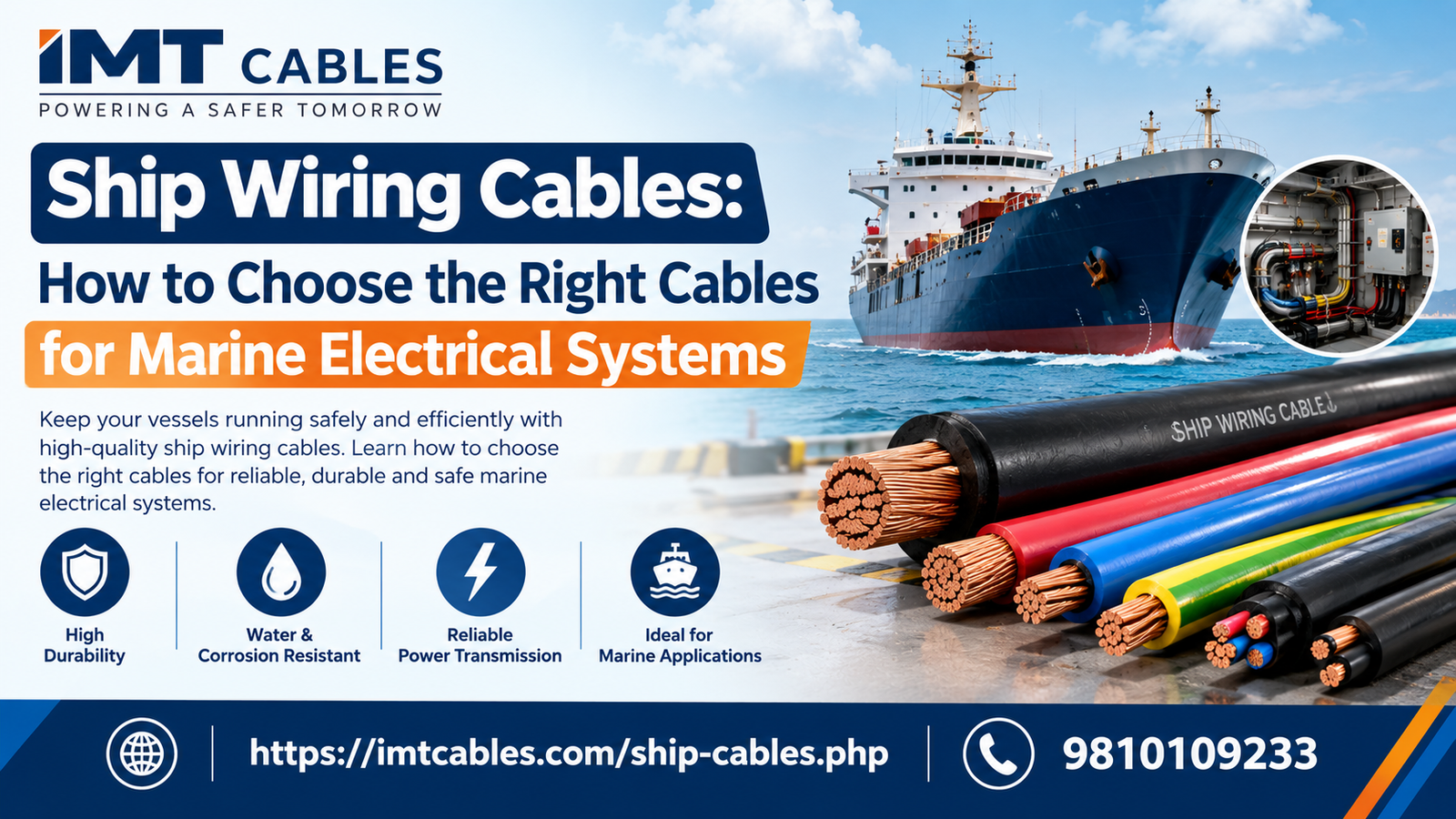
A ship is a floating industrial site, and almost everything on board depends on electricity. Engines, pumps, navigation equipment, lighting, communication systems and control panels all rely on cables that carry power and signals day after day, often in conditions that are tougher than those on land.
That’s why ship wiring cables deserve careful selection. Moisture, vibration, temperature changes, oils and constant movement all place demands on the cable. A cable that’s well matched to its role supports reliable performance, operational safety and dependable electrical connectivity. A poorly matched one can become a recurring maintenance problem or a safety concern.
This guide explains what ship wiring cables are, their key features and types, how to choose them and what to check before you buy. It’s written for shipbuilders, marine engineers, electrical contractors and procurement professionals.
What Are Ship Wiring Cables?
Ship wiring cables, also called marine electrical cables or shipboard wiring, are cables designed for the electrical systems of vessels. They connect and supply:
- Electrical equipment: Motors, pumps, generators and machinery.
- Control systems: Panels, switchgear and automation.
- Lighting: Internal and external lighting circuits.
- Communication systems: Onboard communication and signalling.
- Other onboard applications: Navigation, instrumentation and auxiliary systems.
They’re different from general-purpose building wiring because the marine environment is more demanding. Which cable is suitable depends on the application, the vessel and the specifications that apply.
Key Features of Marine Wiring Cables
Marine wiring cables are usually chosen with these characteristics in mind, though the exact requirements depend on the specification:
- Flexibility: Easier routing around equipment and through tight spaces, and better tolerance of vibration.
- Insulation quality: Reliable electrical insulation suited to the voltage and conditions.
- Resistance to moisture: Important in humid, damp and splash-prone areas.
- Resistance to oil and chemicals, where applicable: Relevant in engine rooms and machinery spaces.
- Mechanical durability: Protection against abrasion, bending and handling during installation.
- Temperature tolerance: Suitability for the operating temperatures in the area where the cable runs.
- Suitability for marine environments: Overall construction that suits shipboard conditions.
Not every cable needs every feature. The location and role of the cable determine what matters most.
Types of Ship Wiring Cables
Different circuits call for different cable types. Common categories include:
- Power cables: Carry electrical power to equipment and distribution points.
- Control cables: Carry signals that operate and monitor equipment.
- Instrumentation cables: Carry measurement and monitoring signals, often needing protection from interference.
- Communication cables: Support data and communication systems.
- Fire-resistant or fire-survival cables: Used where circuits must keep working during a fire, where the design and rules call for them.
The correct type depends on the application and the applicable specifications for the vessel. Always confirm requirements with the design documents and relevant authorities.
Cable Types at a Glance
| Cable Type | Typical Role | Selection Notes |
| Power cables | Supply power to equipment | Match voltage rating, conductor size and load |
| Control cables | Carry operating and monitoring signals | Consider the number of cores and environment |
| Instrumentation cables | Carry measurement signals | May need screening or shielding against interference |
| Communication cables | Support data and communication | Match the communication system’s requirements |
| Fire-resistant cables | Maintain circuits in fire conditions | Check the tested performance and applicable rules |
How to Choose the Right Ship Wiring Cables
Voltage Rating
The cable must suit the voltage of the circuit. Using a cable below the required rating creates safety risks.
Conductor Material and Size
Conductor material affects conductivity, flexibility and durability. Size determines how much current the cable can carry, so size it according to the load, the installation conditions and the manufacturer’s data.
Insulation and Sheath Materials
Insulation and sheath materials influence heat resistance, flexibility, durability and how the cable responds to its surroundings. Check the materials listed in the specification and confirm that they suit your application.
Operating Temperature
Consider the highest and lowest temperatures the cable will face, including heat from nearby equipment, such as in engine rooms.
Installation Conditions
Consider how the cable will be routed, supported, bent and protected. Bundled cables, enclosed spaces and long runs can all affect the choice.
Flexibility
Cables that must bend, move or run through tight spaces may need a more flexible construction than cables in fixed positions.
Environmental Exposure
Think about moisture, salt-laden air, oil, chemicals, abrasion and vibration. Some areas of a vessel are far harsher than others.
Compatibility with the Electrical System
Make sure the cable suits the equipment, connectors and the system’s design requirements.
The Importance of Marine Standards and Certifications
Marine electrical installations are normally governed by design rules and standards, and classification societies often apply their own requirements. Standards such as the IEC 60092 series are commonly referenced for shipboard electrical installations, though the requirements that apply to your vessel depend on its type, flag and class.
When evaluating a cable, ask for:
- Applicable standards: Which standards the product is stated to meet.
- Test reports: Evidence for the stated properties.
- Approvals: Any approvals relevant to your vessel or class.
- Manufacturer documentation: Datasheets and technical information.
Never assume a cable complies with a standard or holds an approval. Ask for documentation and verify it against your project’s requirements.
Applications of Ship Wiring Cables
Marine electrical cables are used across a vessel, including:
- Power distribution: From generators and switchboards to equipment.
- Engine rooms: Where heat, oil and vibration are common.
- Navigation equipment: Systems that need dependable connections.
- Lighting: Throughout accommodation, decks and working areas.
- Control panels: Wiring for monitoring and control.
- Communication systems: Signalling and data connections.
- Other shipboard installations: Auxiliary systems and onboard machinery.
Common Mistakes to Avoid
- Choosing on price alone: The cheapest cable may not suit the environment or the rules that apply.
- Overlooking environmental conditions: Moisture, oil, heat and vibration can shorten the life of unsuitable cables.
- Using incorrect cable sizes: Undersized cables can overheat and fail early.
- Ignoring installation requirements: Poor routing, support or bending can damage cables.
- Failing to check specifications: Don’t rely on general descriptions or verbal assurances.
- Skipping documentation: Request datasheets and test reports where they matter.
These mistakes can affect reliability and safety, and they’re often easier to avoid than to fix after installation.
Benefits of Choosing a Reliable Cable Manufacturer
A dependable manufacturer or supplier can help in several ways:
- Consistent product quality: Repeat orders should match earlier ones.
- Clear technical specifications: Details you can compare against your requirements.
- Suitable product recommendations: Guidance based on your application.
- Dependable supply: Predictable availability that supports project schedules.
- Technical assistance: Help when selecting and specifying cables.
| What to Ask a Manufacturer | Why It Matters |
| Datasheets and specifications | Confirm suitability for your application |
| Test reports and approvals | Support compliance checks |
| Customisation options | Help with project-specific needs |
| Lead times and supply | Protect your schedule |
| Technical support | Eases selection and installation |
Why Consider IMT Cables?
IMT Cables is a cable manufacturer you can contact to enquire about cable solutions for your requirements. You can find out more on the IMT Cables ship cables page and then get in touch to discuss your application, voltage, conductor requirements and installation conditions. As with any supplier, we recommend asking for documentation relevant to your project, including applicable standards and approvals, before making a decision.
Frequently Asked Questions
What are ship wiring cables used for?
They supply power and carry signals for equipment, lighting, control systems, communication systems and other onboard applications on vessels.
What factors should be considered when selecting marine cables?
Consider voltage rating, conductor material and size, insulation and sheath materials, operating temperature, installation conditions, flexibility, environmental exposure and compatibility with the electrical system. Also check applicable standards and documentation.
What is the difference between marine power cables and control cables?
Power cables carry electrical power to equipment, while control cables carry lower-level signals used to operate and monitor systems. Each is chosen according to its role, load and environment.
Why is insulation important in ship wiring cables?
Insulation separates conductors and protects against electrical faults. It also influences how the cable copes with heat, moisture, oil and mechanical wear, so it should suit the voltage and operating conditions.
How can buyers identify suitable cables for marine electrical systems?
Review the project specifications, compare technical datasheets, check applicable standards and approvals and ask the manufacturer for documentation. For complex or safety-critical systems, consult qualified marine electrical professionals.
Conclusion
Choosing ship wiring cables is about matching the cable to its job. Consider the voltage rating, conductor size, insulation and sheath, temperature, installation conditions, flexibility and exposure, and verify standards and approvals through documentation rather than assumption.
A careful selection supports reliable operation and safer electrical systems on board. If you’d like to discuss your requirements, we invite you to contact IMT Cables for product information and assistance.
Get in Touch
IMT Cables
Email: info@imtcables.com
Phone: +91 9810109233
Address: A-96, Mayapuri Industrial Area, Phase-II, New Delhi – 110064, India
Website: https://imtcables.com/