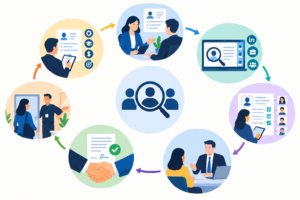
Recruiting employees is an important responsibility for every growing business. A company needs more than a large number of applicants to fill an open position. It needs a structured process for identifying suitable candidates, evaluating their skills, communicating with them, and helping successful candidates transition into their new roles. Full Cycle Recruitment provides an approach that connects these different stages of hiring.
For employers, understanding what full cycle recruitment means and why it matters can help create a more organized and consistent hiring process.
What Is Full Cycle Recruitment?
Full cycle recruitment is an end-to-end approach to hiring. Instead of treating sourcing, screening, interviewing, and onboarding as completely separate activities, the process connects them into one recruitment cycle.
A recruiter or recruitment team may manage several responsibilities throughout this cycle. These can include understanding the employer’s requirements, creating candidate profiles, sourcing applicants, screening resumes, coordinating interviews, assisting with offers, and supporting onboarding.
The exact process can differ depending on the employer, industry, and type of position.
Why Does Full Cycle Recruitment Matter?
A structured recruitment process matters because every stage of hiring is connected. Decisions made at the beginning can affect the quality and efficiency of later stages.
For example, if a job description does not clearly explain the requirements of a position, recruiters may attract candidates who are not suitable. This can lead to more applications to review and make the screening process longer.
By establishing clear requirements at the beginning, recruiters can make the candidate search more focused.
Better Organization
One of the main advantages of an end-to-end recruitment approach is organization. When recruitment activities are coordinated as part of one process, it becomes easier to track candidates and understand their progress.
Recruiters can maintain communication with candidates, coordinate interviews, and provide updates to hiring managers. This can help reduce unnecessary delays during the hiring process.
Consistent Candidate Communication
Candidates often interact with several people during recruitment. Poor communication can create confusion about interview schedules, job expectations, or next steps.
With a connected recruitment process, communication can be managed more consistently. Candidates can receive relevant information at different stages and know what to expect as they move through the hiring process.
A professional candidate experience can also help employers present their organization clearly to potential employees.
Efficient Candidate Screening
Full cycle recruitment also gives recruiters an opportunity to connect sourcing with screening. Instead of simply collecting applications, recruiters can search for candidates according to specific requirements.
They can then assess resumes, experience, qualifications, and other relevant information before presenting suitable candidates to the employer.
This approach can help hiring managers spend more time evaluating qualified candidates rather than sorting through a large number of unrelated applications.
Support for Hiring Managers
Hiring managers have their own responsibilities within a business, so managing every recruitment task can take valuable time.
A recruitment provider such as DSD Recruitment can assist with different parts of the hiring process. This can allow employers to maintain their focus on business operations while receiving professional support with recruitment activities.
A More Connected Hiring Process
Another reason full cycle recruitment matters is that it creates continuity. Information gathered during the initial consultation can guide sourcing and screening, while feedback from interviews can help recruiters understand what the employer needs from future candidates.
This ongoing communication can make the recruitment process more adaptable.
Conclusion
Full cycle recruitment is an end-to-end approach that connects the key stages of hiring, from identifying a vacancy and sourcing candidates to interviews, selection, and onboarding. It can help employers organize recruitment activities, maintain communication, and manage candidate progress more effectively.
For businesses that want a structured recruitment process, understanding how each stage works together can provide a useful foundation for making hiring decisions and managing future vacancies.