Every mechanic knows the routine. A carburettor arrives caked with varnish, an injector is clogged with deposits, or an engine component is coated in oil and carbon. Before anything can be inspected, measured or reassembled, it has to be properly clean.
Component cleaning is one of the most repetitive jobs in a workshop, and one of the easiest to get wrong. Residue left behind can hide wear, cracks or damage, and it can interfere with how parts fit and perform once reassembled. Manual scrubbing works for many jobs, but it takes time and depends heavily on the person doing it.
That is why many service centres and maintenance teams are looking at ultrasonic cleaning. Used with compatible parts, it can remove oil, grease, carbon deposits and dirt, including from places a brush cannot reach. This guide explains how an ultrasonic cleaner for automotive workshops works, what it can clean, what to check before buying, and how to match a machine to your daily workload.
What Is an Ultrasonic Cleaner for Automotive Workshops?
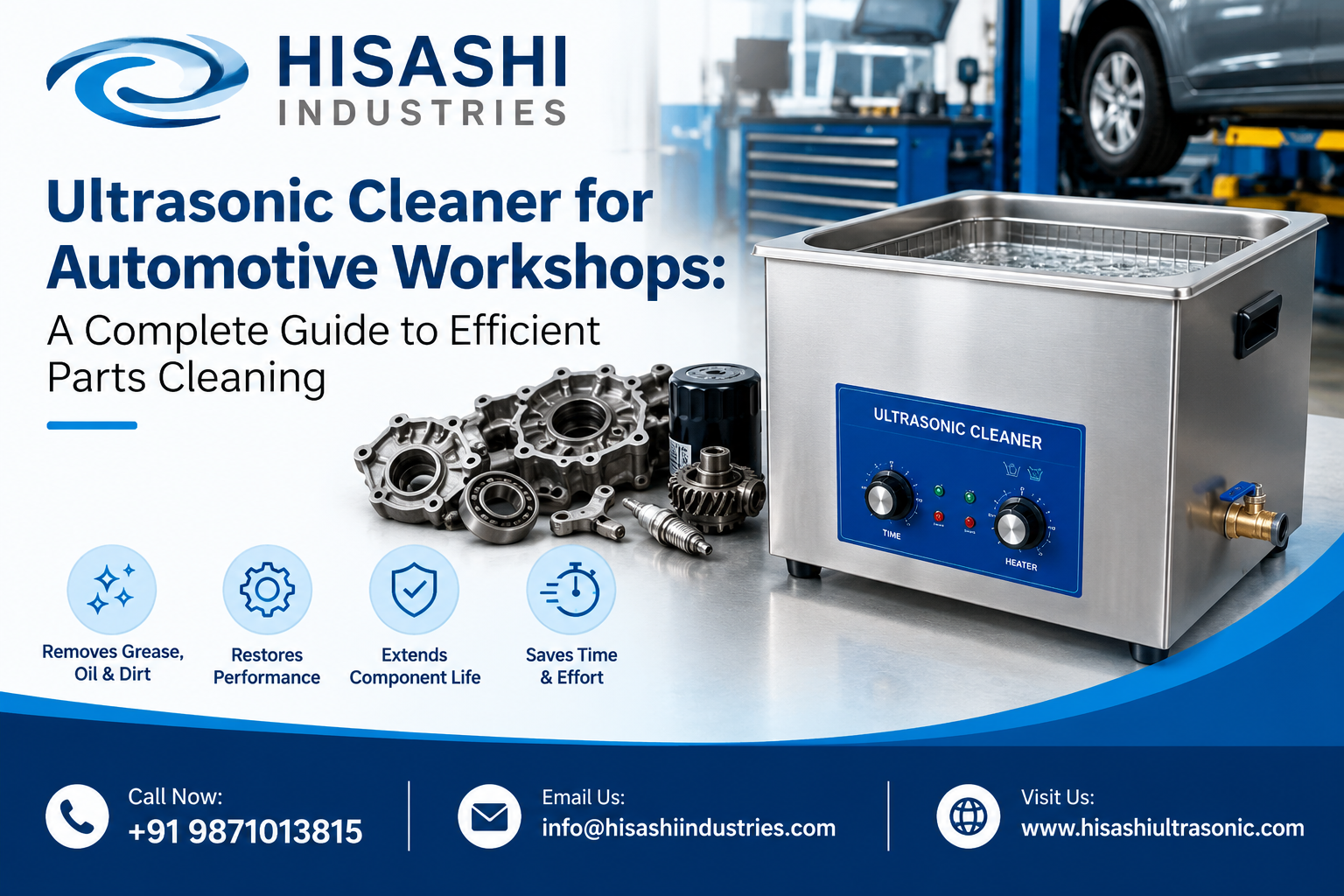
An ultrasonic cleaner is a machine that uses high-frequency sound waves, passed through a liquid, to clean objects submerged in it. The core of the system is a tank, a set of transducers that generate the ultrasonic waves, and a generator that powers them.
The cleaning action comes from a process called cavitation. As the sound waves travel through the cleaning solution, they create alternating zones of high and low pressure. In the low-pressure zones, millions of microscopic bubbles form. In the high-pressure zones, those bubbles collapse rapidly.
Each collapse releases a tiny burst of energy right at the surface of the part. Together, these bursts help dislodge contaminants such as oil, grease, carbon and fine dirt. Because the liquid flows into every opening it can reach, cavitation can act on internal passages, threads, blind holes and complex shapes that are difficult to clean by hand.
How Does Ultrasonic Cleaning Work?
The basic process is straightforward, though good results depend on getting the details right.
- Place compatible components in the tank. Parts are usually loaded into a basket or tray so they do not rest directly on the tank bottom. Check that the material and construction of each part are suitable.
- Add an appropriate cleaning solution. The tank is filled with a solution matched to the contaminant and the material, for example a degreasing solution for oily parts.
- Generate cavitation. The ultrasonic generator is switched on, and the transducers send waves through the liquid.
- Remove loosened contaminants. Cavitation helps lift dirt, grease and carbon away from surfaces and out of narrow spaces. Over time, these contaminants collect in the solution or settle in the tank.
- Rinse and dry when required. Many parts need a rinse to remove leftover solution, followed by drying, especially before inspection, assembly or applying a protective coating.
The cleaning solution, temperature, ultrasonic frequency and cycle duration should all be chosen to suit the component material and the type of contamination. A heavily carbonised metal part and a lightly oiled fastener, for instance, will not need the same settings. When in doubt, start with a gentler approach and test on a sample part.
Automotive Parts That Can Be Cleaned
Ultrasonic cleaning can be a good fit for many metal components commonly seen in workshops, including:
- Carburettors, including jets and passages affected by varnish and deposits
- Fuel injectors, where small internal openings are difficult to clean manually
- Engine components, such as pistons and other parts coated in oil and carbon
- Valves and valve-related parts
- Metal fasteners such as nuts, bolts and washers, which can be cleaned in batches
- Selected transmission parts, subject to material compatibility
- Other compatible components that can safely be immersed in a liquid
Not everything should go into an ultrasonic tank. Sensitive electronics, coated surfaces, seals, and delicate or sealed assemblies need a compatibility check first. Some coatings can be damaged by cavitation or by certain cleaning chemicals, and some assemblies should not be immersed at all. If you are unsure, check the manufacturer’s guidance for the part and the equipment, and test before running a full batch.
Key Benefits for Automotive Workshops
When the process is set up correctly, ultrasonic cleaning offers several practical advantages:
- Consistent results. Once the solution, temperature and cycle time are set, the process is repeatable and depends less on individual technique.
- Access to complex shapes and narrow passages. Cavitation acts wherever the liquid reaches, including areas a brush or cloth cannot.
- Less manual scrubbing. Technicians can spend less time on repetitive cleaning and more on diagnosis and repair.
- Better workshop productivity. Parts can be cleaned while other work continues, which can help workflow.
- Less risk from abrasive methods. Wire brushes and harsh scraping can scratch or wear surfaces. Ultrasonic cleaning avoids much of this when the parameters are chosen properly.
- Better preparation for inspection and reassembly. Clean parts make it easier to see wear, measure tolerances and fit components correctly.
Actual results will always depend on the part, the contamination, the equipment and the cleaning process, so it is sensible to treat these as potential advantages rather than guaranteed outcomes.
Types of Automotive Ultrasonic Cleaning Machines
An automotive ultrasonic cleaning machine is not a one-size-fits-all product. The main categories are:
Compact single-tank cleaners. These suit smaller workshops or parts such as injectors, carburettor components and small fittings. They take up little space and are a common starting point.
Industrial-capacity systems. Larger tanks handle bigger or heavier components such as engine parts, and higher daily volumes. They are more suitable for busy service centres and maintenance departments.
Multi-stage cleaning solutions. These combine several stages, for example cleaning, rinsing and drying, in one workflow. They help when parts must go through a consistent, repeatable sequence, and they can reduce handling between steps.
The right option depends on four things: the size of your components, how many parts you clean each day, how heavy the contamination usually is, and how cleaning fits into your existing workflow. A workshop that cleans a few injectors a week has very different needs from one processing large batches of engine parts every day.
Comparison: Traditional Cleaning vs Ultrasonic Cleaning
| Factor | Traditional Cleaning | Ultrasonic Cleaning |
| Cleaning method | Manual brushing or wiping | Cavitation in a cleaning solution |
| Complex components | May require extra manual effort | Can reach many intricate areas |
| Labour requirements | Often labour-intensive | Reduces repetitive scrubbing |
| Cleaning consistency | Depends on operator technique | Repeatable with controlled settings |
| Suitable applications | General surface cleaning | Compatible precision components |
| Important consideration | Choose suitable tools and cleaners | Check material and solution compatibility |
Neither method is automatically better in every situation. Results depend on the component, the contamination, the equipment and the cleaning process. Many workshops use both, relying on manual methods for large or non-immersible parts and ultrasonic cleaning where thorough, repeatable cleaning matters.
How to Choose the Right Machine
Before choosing equipment, take a close look at what your workshop actually cleans. These factors matter most:
- Tank capacity. Make sure the tank holds your typical load comfortably, with room for a basket.
- Component dimensions. Check the size of your largest and most common parts, not only the average ones.
- Ultrasonic frequency. Different frequencies suit different tasks and materials, so ask the supplier which suits your parts.
- Heating options. Warmer solutions often help with oils and grease, so check whether heating is available and controllable.
- Filtration. Filtration can help keep the solution cleaner for longer, depending on your contamination level.
- Automation. Consider whether you need manual operation or an automated sequence for higher volumes.
- Cleaning chemicals. Solutions should match both the contaminant and the metal being cleaned.
- Maintenance requirements. Ask what routine care, solution changes and servicing the machine needs.
- After-sales support. Reliable support matters when equipment becomes a daily part of your workflow.
Start by listing the parts you clean, their material, their typical contamination and how many you handle per day. That list will make any conversation with a supplier far more productive.
Why Consider Hisashi Industries?
Hisashi Industries provides ultrasonic cleaning solutions for automotive and industrial applications. Its official website lists an automotive range that includes an automotive ultrasonic cleaner, an automatic ultrasonic washer for auto components, an engine degreasing ultrasonic cleaning machine, an ultrasonic auto parts cleaner and an ultrasonic piston cleaning machine. The company also offers other ultrasonic cleaners, including single-stage industrial, table-top and multi-stage aqueous systems, along with cleaning chemicals.
For specific machine configurations, features and specifications, the best source is the official website at hisashiultrasonic.com. When you contact the team, it helps to share the dimensions of your components, the material they are made from and the type of contamination you need to remove. With that information, a supplier can help identify a machine and process that suit your requirements.
Frequently Asked Questions (FAQs)
- What is an ultrasonic cleaner used for in automotive workshops?
It is used to clean automotive components by removing oil, grease, carbon deposits and dirt. Ultrasonic waves create cavitation in a cleaning solution, helping to clean surfaces and hard-to-reach areas on compatible parts.
- Which automotive components can be cleaned using ultrasonic technology?
Common examples include carburettors, fuel injectors, engine components, valves, metal fasteners and selected transmission parts. Suitability depends on each part’s material, construction and condition. Sensitive electronics, coatings, seals and delicate assemblies should be checked first.
- How does an automotive ultrasonic cleaning machine work?
Parts are placed in a tank filled with a suitable cleaning solution. Transducers generate high-frequency sound waves that form microscopic bubbles. When these bubbles collapse, they help loosen and lift contaminants from the part. Parts are then rinsed and dried if required.
- Is ultrasonic cleaning suitable for carburettors and fuel injectors?
It is widely used for these parts because they contain small passages that are hard to clean by hand. However, you should confirm that the materials and any attached components are compatible with the cleaning solution and process before starting.
- How do I choose the right ultrasonic cleaner for my workshop?
Start with your real needs: the size of your parts, daily cleaning volume, contamination level and workflow. Then compare tank capacity, frequency, heating, filtration, automation, maintenance needs and after-sales support, and discuss your requirements with the supplier.
- Can ultrasonic cleaning replace all traditional automotive cleaning methods?
Not necessarily. It is highly effective for many compatible parts, but large components, non-immersible assemblies and certain materials may still call for other methods. Many workshops use ultrasonic cleaning alongside traditional techniques.
Conclusion
Clean components are the starting point for accurate inspection, reliable assembly and well-run maintenance. Ultrasonic cleaning can support that by delivering more consistent results, reaching complex shapes and reducing repetitive manual effort, provided the machine, solution and settings are matched to the job.
The key is to choose equipment based on your workshop’s real needs: the parts you clean, the contamination you face and the volume you handle. Take time to check material compatibility, ask about maintenance and support, and test before committing to a full process.
If you are considering an ultrasonic cleaner for your own workshop, Hisashi Industries is worth exploring. Its range of automotive ultrasonic cleaning solutions covers a variety of applications, and the team can discuss your specific requirements.
Call Now: +91 9871013815
Email Us: info@hisashiindustries.com
Visit Us: https://hisashiultrasonic.com/
Address: Khasra No 483, near Eco Tech 12, Sadullapur, Greater Noida, Uttar Pradesh 203207