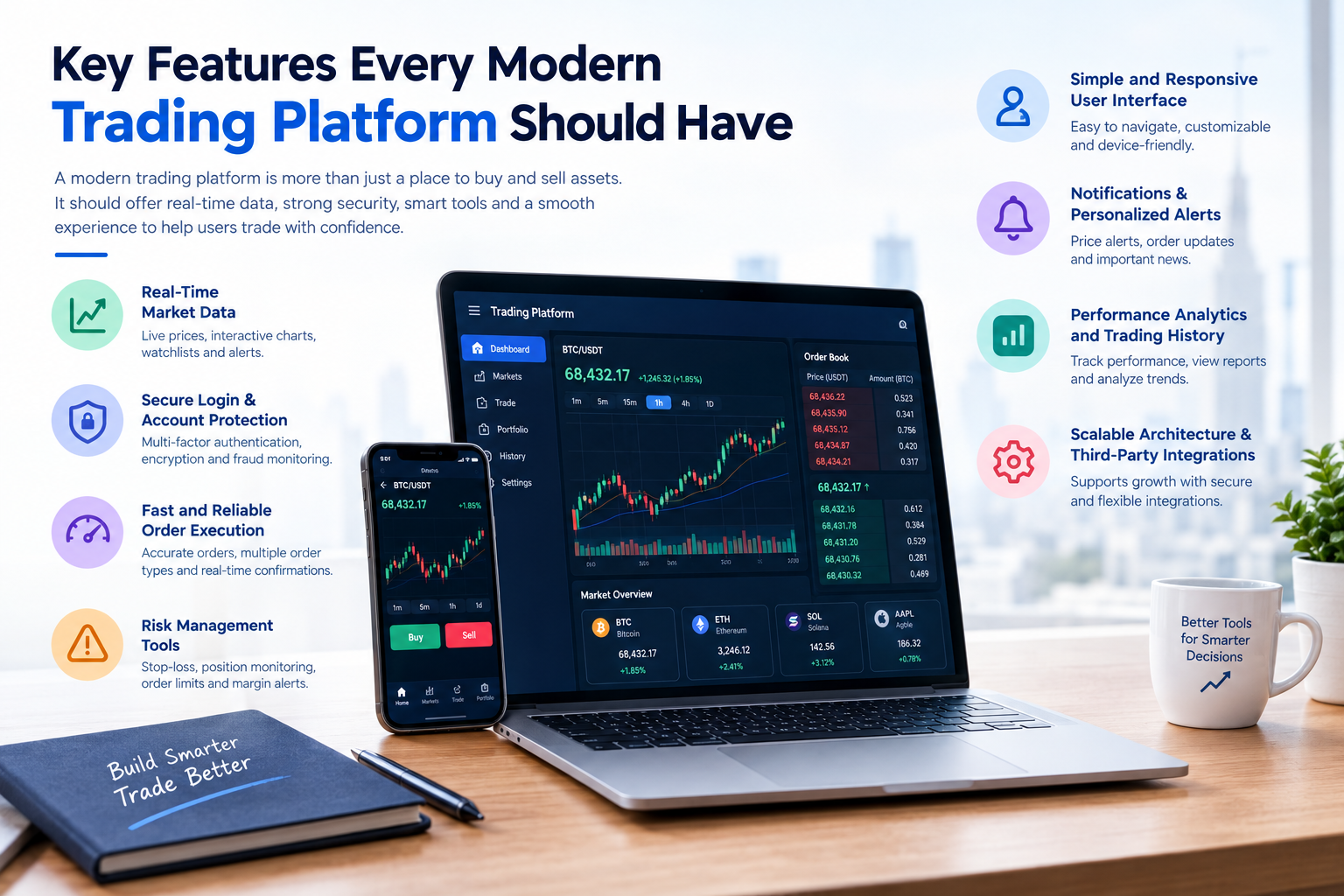
Trading has become increasingly digital, and users now expect more than a place to buy and sell financial assets. They need platforms that provide real-time market information, smooth order execution, strong security, and tools that help them make informed decisions. For businesses entering this market, choosing the right features is an important step toward building a reliable trading solution.
The importance of risk management is also reflected in guidance from the U.S. Securities and Exchange Commission (SEC). The SEC requires covered broker-dealers with market access to maintain controls designed to limit financial exposure, prevent certain erroneous orders, and support regulatory compliance. This highlights why risk controls should be considered during trading platform planning, not added as an afterthought.
Whether you are building a stock trading application, a cryptocurrency exchange, or a multi-asset trading solution, the right combination of features can improve usability, security, and operational efficiency.
1. Real-Time Market Data for Better Trading Decisions
Market prices can change quickly, so traders need accurate and timely information to make decisions. A modern trading platform should display live or appropriately updated prices, market movements, trading volume, and relevant financial news.
Useful market data features include:
- Live price updates: Help users follow price movements without repeatedly refreshing the screen.
- Interactive charts: Allow traders to study price trends using different time frames and technical indicators.
- Watchlists: Enable users to track selected stocks, currencies, commodities, or other supported assets.
- Market alerts: Notify users about price changes or other events based on their preferences.
The platform should also communicate whether market data is real-time or delayed. Data licensing, exchange connectivity, and infrastructure requirements must be considered during development.
2. Secure Login and Strong Account Protection
Security is one of the most important features of any trading platform because users may connect their accounts, personal information, and financial assets to the service.
A well-designed platform should include multiple layers of protection, such as:
- Multi-factor authentication (MFA): Adds an extra verification step beyond a password.
- Data encryption: Protects sensitive information during transmission and, where appropriate, storage.
- Role-based access controls: Restrict administrative functions to authorized personnel.
- Session management: Helps detect suspicious activity and manage active sessions.
- Audit logs: Record important account and administrative actions for monitoring and investigation.
Depending on the platform’s market and business model, additional identity verification, anti-money laundering controls, and other regulatory requirements may apply. These should be defined with qualified compliance professionals.
3. Fast and Reliable Order Execution
A trading platform must handle orders accurately and communicate their status clearly. Delays, duplicate submissions, or unclear confirmations can create frustration and financial risk.
Essential order management features include market and limit orders where supported, order modification and cancellation, execution confirmations, and a clear order history. The platform should also show relevant order statuses, such as pending, partially filled, filled, or rejected.
Reliable trading platform software development requires careful integration with brokers, exchanges, liquidity providers, or other execution venues. Performance testing should cover high traffic, connectivity failures, and unexpected order volumes.
Importantly, fast execution alone is not enough. Pre-trade validation and appropriate risk controls can help prevent invalid orders from reaching the market.
4. Built-In Risk Management Tools
Trading involves financial risk, so platforms should give users and operators practical tools to monitor exposure and respond to potential problems.
Depending on the type of trading service, useful controls may include:
- Position monitoring: Shows open positions and relevant exposure information.
- Loss and exposure alerts: Notifies users when configured thresholds are reached.
- Order limits: Helps enforce permitted order sizes, values, or quantities.
- Margin monitoring: For applicable leveraged products, displays margin requirements and warnings.
- Automated safeguards: Rejects orders that violate configured rules or exceed applicable limits.
The exact controls depend on the assets traded, the platform’s operating model, and the applicable regulations. Risk management should be designed around those requirements rather than treated as a generic feature checklist.
5. A Simple and Responsive User Interface
Even a technically advanced trading platform can struggle if users find it difficult to navigate. A clear interface helps beginners understand essential actions while giving experienced traders quick access to important information.
A user-friendly design should provide a clean dashboard, readable charts, intuitive navigation, customizable watchlists, and clear transaction confirmations. Responsive layouts are also essential so users can access the platform on desktops, tablets, and smartphones.
Businesses working with a custom mobile application development company can plan a consistent experience across web and mobile applications. However, each interface should be designed around its device, user needs, and most common trading tasks.
6. Notifications and Personalized Alerts
Traders cannot monitor every market movement throughout the day. Timely notifications help them stay informed without keeping the application open constantly.
Useful notification options include price alerts, order execution updates, account activity warnings, margin notifications where relevant, and important platform announcements.
Users should be able to manage their alert preferences and choose suitable delivery channels, such as in-app notifications, email, or push notifications. Alerts should be relevant and reliable, while sensitive information should not be exposed on unsecured notification previews.
7. Performance Analytics and Trading History
Trading history and analytics help users review their activity and understand patterns in their decisions. A modern platform can provide transaction records, realized and unrealized profit or loss where applicable, portfolio allocation, and performance summaries.
For more advanced users, customizable reports and downloadable statements can support recordkeeping and analysis. The platform should clearly explain calculation methods and account for relevant fees, currency conversions, and other factors when presenting performance figures.
These features can also support customer service and operational teams by making account activity easier to review.
8. Scalable Architecture and Third-Party Integrations
A trading platform needs a technical foundation that can support growth without compromising reliability. Its architecture should account for market data volume, user activity, order processing, storage, and recovery from service disruptions.
Integrations may include market data providers, payment services, identity verification systems, broker APIs, analytics tools, and regulatory reporting solutions. Each integration introduces dependencies that must be secured, tested, and monitored.
This is where custom trading platform development can be useful. Instead of relying entirely on a generic solution, businesses can build workflows and integrations around their specific users, supported markets, and operational requirements. The scope should be planned carefully to avoid unnecessary complexity and cost.
How to Choose the Right Features for Your Trading Platform
Not every platform needs every feature at launch. Start by identifying your target users, the assets you plan to support, the jurisdictions in which you will operate, and the problems your platform must solve.
Then prioritize the essentials: security, accurate market data, reliable order handling, risk controls, and a straightforward user experience. Advanced analytics, automation, and additional integrations can be introduced as business needs develop.
When evaluating custom trading software development services, review the provider’s experience with financial integrations, security testing, performance engineering, maintenance, and compliance-related requirements. A development partner should be able to explain the technical trade-offs, not simply promise a long list of features.
Final Thoughts
A modern trading platform needs more than attractive charts and a convenient dashboard. It should combine reliable market data, secure accounts, accurate order management, risk controls, useful analytics, and a scalable technical foundation.
By selecting features according to user needs and regulatory obligations, businesses can create a trading experience that is practical, dependable, and ready to evolve. Careful planning during development can also help reduce avoidable rework as the platform grows.